
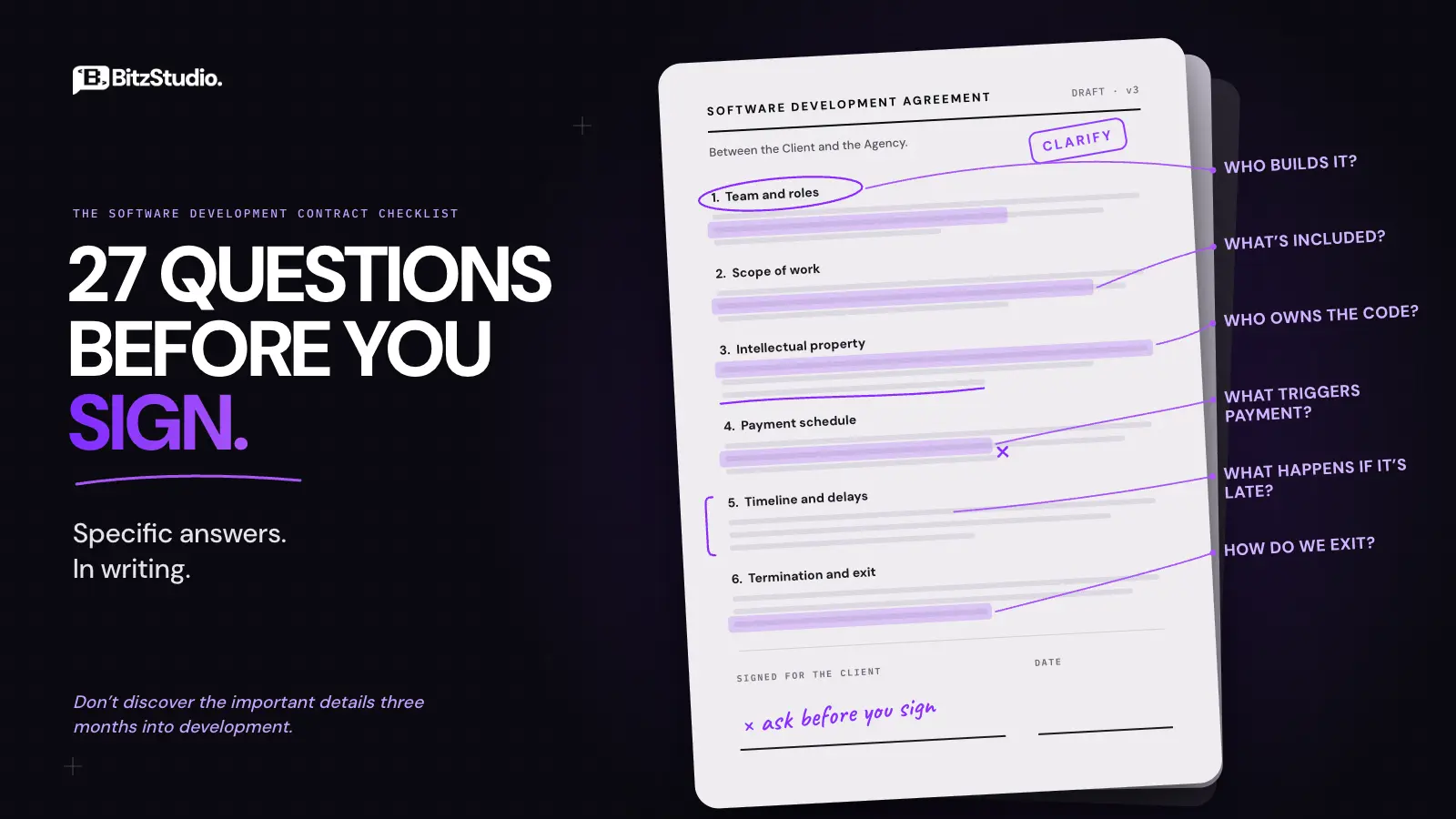
The agency proposal looks excellent; the price is within the said budget, the sales meeting went smoothly. Then, three months later into development, you figure out that the senior developer from the pitch is not working on your project, the critical features are costing extra and there is no answer to who owns the source code.
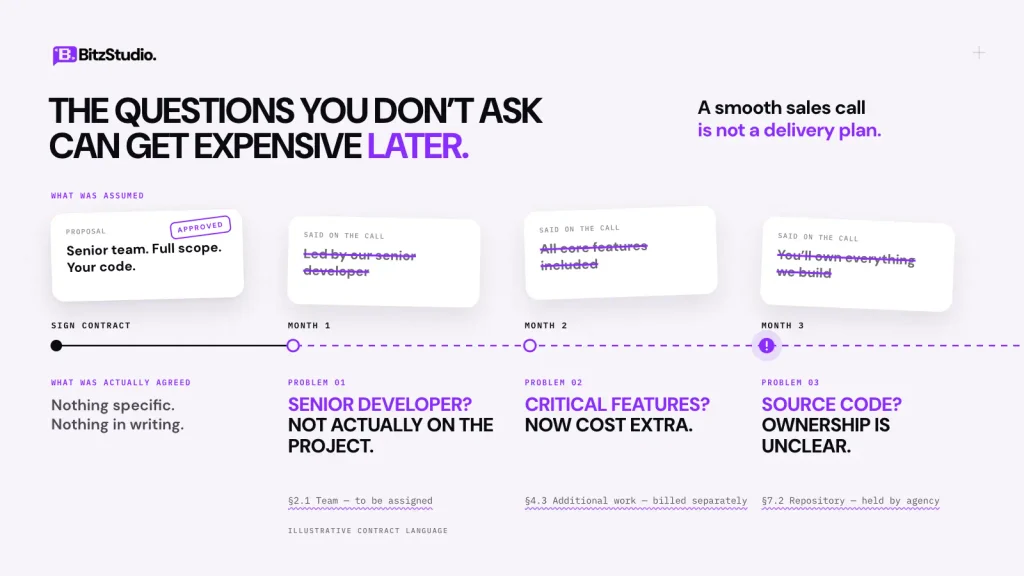
It is easier to prevent these problems before signing the contract rather to untangle them later.
This guide covers 27 questions to ask a software development agency before signing a contract, from delivery and pricing to intellectual property, testing, and handover. Use it alongside our guide to choosing a software development agency. You don’t need perfect answers. You need specific answers you can put in writing.
Quick Checklist: What Should You Confirm Before Hiring?
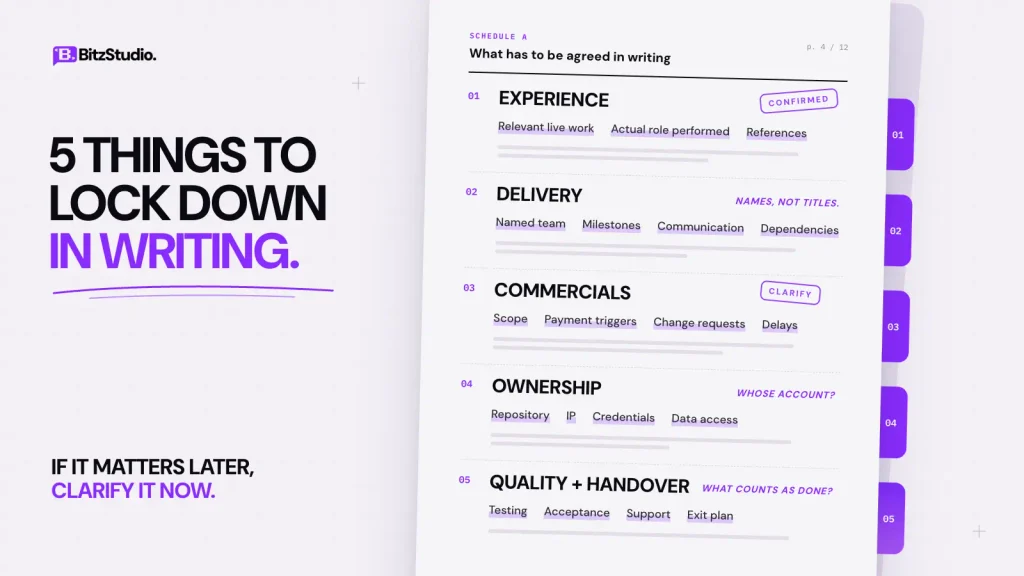
You should verify five things before hiring a development agency. Evidence of comparable work, named people responsible for delivery, a realistic scope and pricing model, clear source-code ownership, and a measurable acceptance and handover process. If an agency fails to explain these before signing the contract the uncertainty usually becomes a risk afterwards.
| Area | What you need in writing |
| Experience | Relevant live work, role performed, client references |
| Delivery | Named team, milestones, communication, dependencies |
| Commercials | Scope, payment triggers, change requests, delays |
| Ownership | Repository, IP assignment, credentials, data access |
| Quality | Testing, acceptance criteria, support, exit plan |
Questions to Ask Before Hiring a Development Agency: Experience and Fit
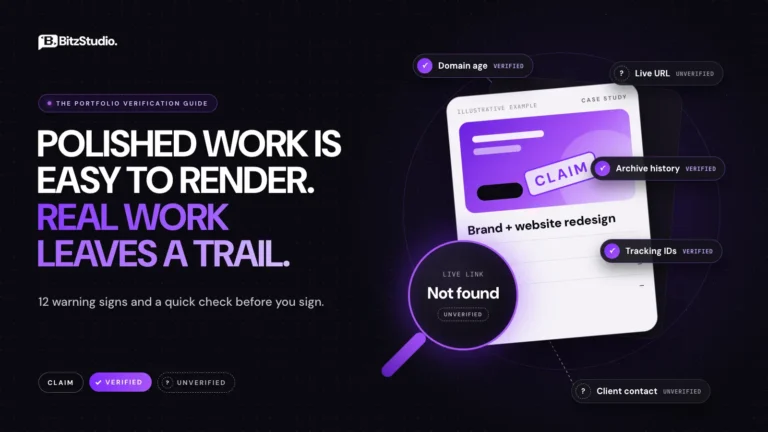
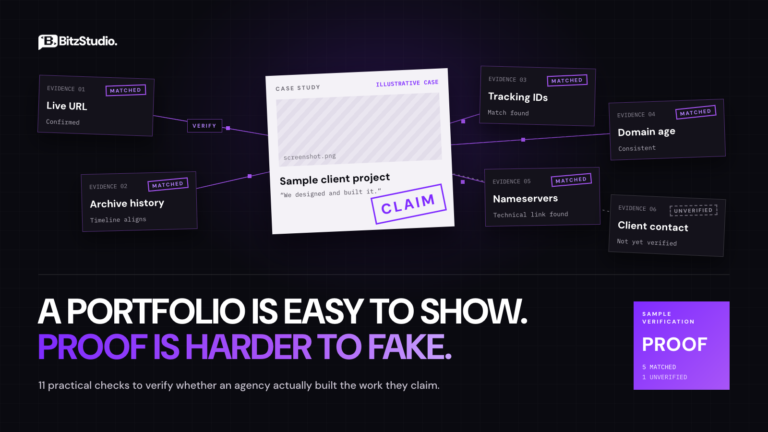
A polished presentation represents how an agency sells. Project evidence shows how it delivers. You should always have a proof specially when your investment is dependent on a product working in the real world.
1. Have you delivered a project with similar complexity?
Do not settle for “we have built apps before”. Ask for comparable integrations, user roles, workflows, or traffic requirements. An attractive marketing website and a multi-tenant SaaS platform demand different skills. Look for: a solid example and explanation of what made it difficult.
2. Can I use a live product you built?
Do request for a working URL or a supervised demo of production application. Test registration, navigation, and mobile behavior where access permits. A static Figma presentation proves design capability, not deployment capability. Look for: an honest differentiation between concepts, staging builds, and launched products.
3. What exactly did your team build in that portfolio project?
Sometimes agencies contribute one component to a project and portray the project as theirs. Ask whether they handled strategy, design, frontend, backend, or maintenance. Learn how to verify the agency built its own portfolio; also question unsupported or AI-generated case studies. Look for: do not settle for vague ownership claims, look for specific responsibilties.
4. Can I speak with a recent client?
Ask for a client with similar project scope and ask for it ideally from the previous one year.Some clients cannot participate because of confidentiality; reasonable alternatives include a permissioned case study or a detailed walkthrough. Look for: consistency between the agency’s claims and an independent account of delivery.
5. Which projects do you decline?
An agency may lack boundaries if it says yes to every industry, budget, timeline, and technology stack. Ask whether they provide a different platform or a different specialist. Look for: the confidence to explain what is outside its strengths. That protects your project more than a universal sales pitch.
Team and Communication: Who Will Actually Do the Work?
The people on the proposal are usually not the ones writing the code. Agree on staffing, authority, and communication before the first invoice; otherwise, changes in personnel become difficult to challenge.
6. Who will be assigned to my project?
Request the agency for names or assigned roles for the technical lead, developers, designer, QA reviewer, and project manager. Clarify whether subcontractors will participate. Look for: a staffing plan that reflects the quoted scope and a clear point of accountability.
7. Will the senior developer from the sales call be involved?
Ask the amount of time an individual will actually spend reviewing architecture or code. A senior person is simultaneously supervising several projects, but their involvement must not disappear. Look for: expected availability and defined responsibilities.
8. Can we request dedicated engineers or replace a team member?
For ongoing work, ask about continuity, notice periods, replacement time, and knowledge transfer. A model using dedicated senior engineers may suit evolving roadmaps better than a short fixed build. Look for: a documented replacement process without surprise onboarding charges.
9. How will you report progress and raise blockers?
Agree on demo frequency, written status updates, the project-management tool, and response expectations. A weekly update should include completed work, upcoming work, risks, and decisions needed from you. Look for: access to real progress, not a recurring “everything is on track.”
10. Who makes decisions when requirements conflict?
One stakeholder may demand a feature while other may protect deadlines. Identify the client’s final approver and the agency’s escalation owner. Look for: a decision log and a process for resolving disagreements before they stall a sprint.
Scope, Timelines, and Pricing: What Are You Buying?
A quotation is considered meaningful if only it identifies deliverables and assumptions. Compare proposals against the same written scope, not just the number at the bottom of the page.
11. What is included and explicitly excluded?
Request a statement of work (SOW) listing features, integrations, content responsibilities, supported devices, environments, and exclusions. “User dashboard” is too broad to price safely. Look for: testable requirements and a list of things the estimate does not cover.
12. How did you build the estimate and timeline?
Ask about the assumptions which drive the schedules, what dependencies sit with your team, and where contingency is included. Absolute guarantees without discovery are considered a warning sign. Look for: a plan that explains both uncertainty and effort.
13. What technology will you use, and why?
The right stack depends on maintainability, hiring options, existing systems, and product needs. Ask why the team recommends its approach to custom software development rather than simply choosing what it always uses. Look for: tradeoffs you can understand, including future operating costs.
14. Is fixed price or time and materials better here?
A fixed-price vs. time-and-materials contract decision is dependent on availability of scope. When acceptance criteria are clear, fixed price works the best. Materials and times whereas, can suit evolving products. For a tightly defined MVP build, consider a capped discovery or milestone phase. Look for: an exclusive budget control mechanism in either model.
15. What happens when I request a change?
Agree that every change request identifies scope, added cost, schedule impact, and approver before work starts. A practical rule: no chargeable change begins without written approval from the named client owner. Look for: no verbal approvals that later become disputed invoices.
16. What if a milestone or deadline is missed?
Make it clear whether delivery date is a target date or a contractual commitment. How are delays dealt and which remedies should be applied. Separate agency delays from late client feedback or third-party outages. Look for: documented recovery steps, revised dates, and escalation—not unrealistic promises of zero delays.
17. What triggers an invoice, and can I reject incomplete work?
Payments should be in alignment with clearly defined deliverables or agreed time records. Specify review windows, evidence required, and how defects are handled. Look for: acceptance criteria established before development, not invented when the invoice arrives.
Software Development Contract Checklist: Ownership and Protection
When the relationship ends or the expectations diverge the contract matters the most. Have qualified counsel review jurisdiction-specific terms, especially cross-border work. The points below are commercial safeguards, not legal advice.
18. Who owns the source code and intellectual property?
For IP ownership in a software development contract, distinguish newly created code, the agency’s pre-existing components, open-source dependencies, and third-party licenses. Specify when rights transfer and what rights you receive. Look for: written assignment or licensing terms rather than assuming payment automatically gives unrestricted ownership.
19. Who controls the repository, hosting, and credentials?
Prefer client-controlled Git repositories, cloud accounts, domains, and analytics wherever practical. Document access levels and recovery methods. An escrow arrangement may help with proprietary dependencies but should not replace ordinary access. Look for: the ability to operate without the agency’s personal accounts.
20. How will you protect our data and confidential information?
Ask about NDAs, access controls, backups, vulnerability handling, and subprocessors. If personal data is processed, clarify controller/processor roles and relevant contractual obligations. UK businesses can consult the ICO’s contract guidance. Look for: safeguards appropriate to actual data risk, not a generic “fully secure” claim.
21. What belongs in the SOW, MSA, and support agreement?
A master services agreement (MSA) commonly addresses overarching legal and commercial terms. The SOW defines this project’s scope, milestones, and acceptance tests; a service level agreement (SLA) may define support response commitments. Look for: documents that agree with each other, including termination and dispute provisions.
Quality, Launch, and Handover: What Happens After the Demo?
A working demonstration is not usually considered a finished product. Define what must pass testing, what counts as an accepted release, and what the client receives after launch.
22. What is your QA and testing process?
Ask for who is testing requirement, responsive layouts, integration, permissions, and failed scenarios. A defined QA and testing process should generate evidence of what passed and what remains unresolved. Look for: defects tracked to closure.
23. Who reviews code, including AI-assisted code?
Code requires human accountability though AI tools may speed up development.Ask about peer review, dependency checks, tests, and security-sensitive changes. Look for: named reviewers and standards rather than treating generated code as automatically production-ready.
24. How do you handle deployment, backups, and rollback?
Clarify staging versus production, release approvals, database migrations, backup ownership, and recovery steps. Look for: terms that state what is included rather than an open ended promise to what will be the help after launch.
25. What happens during the warranty or post-launch support period?
Define defect fixes separately from new features. Ask about response hours, severity levels, warranty duration, maintenance fees, and hosting responsibilities. Look for: support terms that specify what is included rather than an open-ended promise to “help after launch.”
26. Can another team maintain the product if we part ways?
Request architecture notes, setup instructions, deployment documentation, third-party license inventory, and an explanation of known limitations. Look for: a plan that is workable and a reasonable assistance requirements, not technical dependencies that forces renewal.
27. What exactly will you deliver at handover?
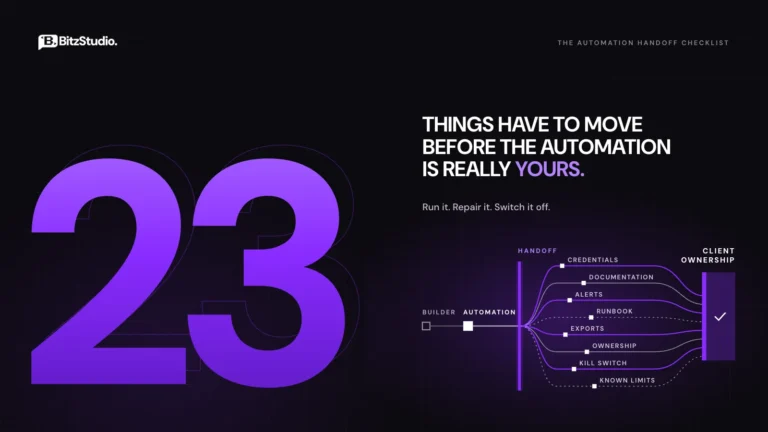
Make handover an acceptance milestone: repository access, documentation, admin credentials, assets, backups, and a walkthrough with your team. Our automation handoff checklist illustrates why verified ownership matters. Look for: someone on your team successfully accessing and operating what was transferred.
Software Development Agency Red Flags That Should Change Your Decision
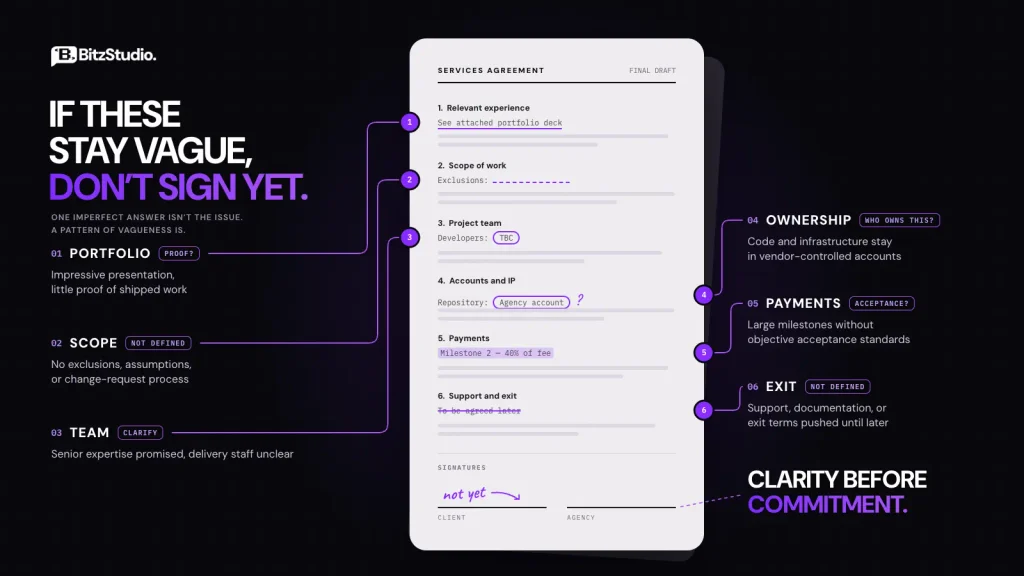
An agency cannot be rejected on the basis of one imperfect answer. A pattern of evasive answers though is. Watch for these:
- The portfolio is impressive but that demonstration is not shipped in work.
- A quote with no exclusions, assumptions, or change-request mechanism.
- Despite promising senior expertise unnamed delivery staff is assigned.
- Infrastructure and code are held exclusively in vendor controlled accounts.
- Large milestone payments without objective acceptance standards.
- Support, documentation, or exit terms postponed until after launch.
You can further check whether visuals are AI generated concepts or are genuine deliverables before treating a case study as client work.
Questions to Ask a Web or App Development Agency
The core 27 questions apply to both, but the technical follow-ups differ. For a web development agency, confirm CMS editing access, accessibility, Core Web Vitals, SEO migration, and browser compatibility. For an app development company, confirm app-store accounts, push notifications, device testing, platform policies, and ownership of signing credentials. SaaS products additionally need tenant isolation, usage limits, and subscription lifecycle testing.
How BitzStudio Approaches a Development Engagement
BitzStudio is a Lahore based company, serving clients internationally with web platforms, custom applications, SaaS products, and mobile development. Our approach is to clarify the scope and delivery responsibilities before moving into implementation, then address design, development, testing, launch, and support as distinct parts of the work.
We do encourage our prospective clients to examine our work, ask who will build their product, and request clear milestones, ownership terms, and handover deliverables. Those are reasonable questions for any agency, including ours.
Frequently Asked Questions
Who owns the code when you hire an agency?
Ownership is dependent upon applicable law and agreement. Ask for explicit terms covering new code, third-party components, and pre-existing agency tools. Confirm access to the repository and the rights needed to operate, modify, and transfer the product.
How much does a development agency charge?
It depends on complexity, team composition, geography, integrations, and engagement model. Compare estimates against identical requirements and ask what is excluded. The cheapest proposal is not necessarily the least expensive product to maintain.
What should a software development contract include?
At minimum, clarify scope, deliverables, milestones, payment terms, change requests, intellectual property, confidentiality, acceptance criteria, warranties, support, termination, and handover. Legal requirements vary by jurisdiction and project type.
What happens if the agency misses the deadline?
The agreed contract should define notification, recovery plans, responsibilities for delay, and applicable remedies. Record dependency-related delays separately from avoidable delivery failures. Avoid relying on verbal assurances.
What are the most important questions to ask before hiring a development agency?
Start with evidence of comparable work, the actual delivery team, the written scope, the change-request process, code ownership, acceptance criteria, and exit plan. Those answers reveal more about delivery risk than a polished pitch.
Before You Sign
You are not buying a promise that nothing will go wrong. You are choosing a team that can explain what it will build, how decisions will be made, and what happens when circumstances change.
Take these questions to your next agency call. Record the answers, request the supporting documents, and compare proposals on evidence rather than presentation. If you are assessing a project with BitzStudio, you can start a conversation about scope and delivery before committing.