
Six months into a build, the senior engineer who impressed you in the pitch meeting has quietly rotated off your project. A junior developer you’ve never spoken to is now committing code. Every small change request comes back with a new quote. Nobody lied to you you just never asked the right questions.
So here’s a fair question: what if the most useful guide to hiring a development partner was written by the kind of company you’re about to evaluate?
That’s what this is. We build software for a living at BitzStudio, which means we’ve spent five years and more than 200 projects on the vendor side of these conversations. We know how estimates get padded, why “senior developer” is a flexible term, and which questions make a sales team shift in their seat. None of that is sinister. It’s just how the business works when a client doesn’t know what to probe.
The stakes justify the effort. The Project Management Institute’s 2026 Pulse of the Profession found that roughly 31% of complex projects fail to deliver the full scope of their intended benefits more than double the rate for projects overall. Custom software is almost always a complex project.
Choosing well is the cheapest risk reduction available to you. Here’s how to do it properly.
First, Decide If You Actually Need an Agency
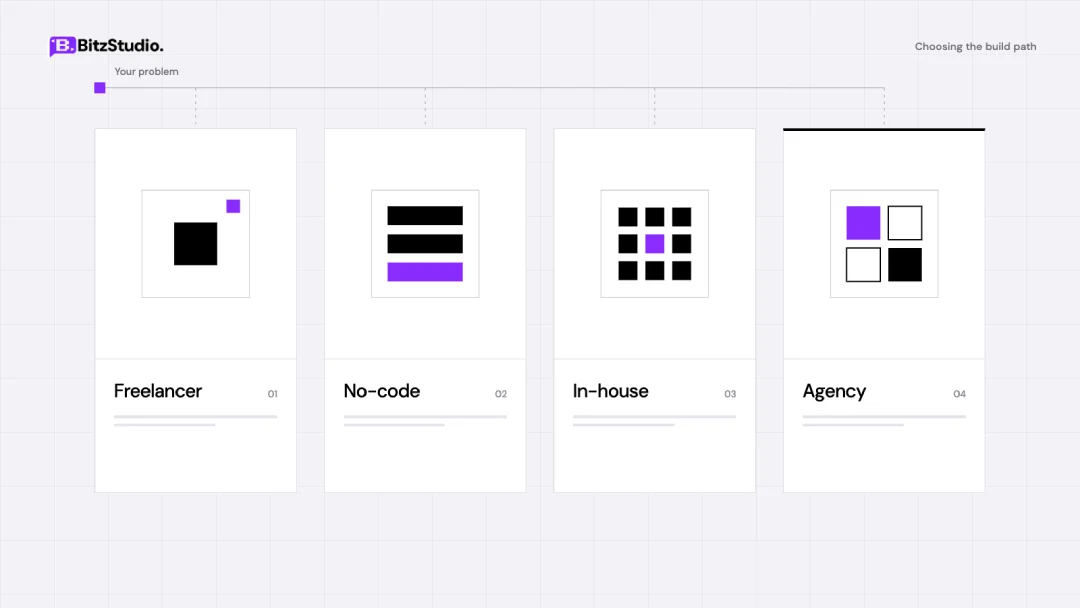
Before comparing vendors, confirm that an agency is the right shape of solution at all. Plenty of projects get handed to agencies when a contractor, a no-code tool, or a single in-house hire would have been faster and cheaper.
The honest version of this decision looks like a comparison, not a pitch:
| Option | Best for | Relative cost | Speed to start | Main risk |
| Freelancer (Upwork, Toptal, Fiverr) | One well-defined feature or fix | $ | Fast | Bus factor of one |
| No-code (Bubble, Webflow, FlutterFlow, Airtable, Zapier) | Validating an idea before you build | $ | Fastest | Hard ceiling on scale and control |
| In-house team | A long-term core product | $$$$ | Slowest | Hiring risk, salary overhead |
| Development agency | 3–18 month builds needing several skill sets at once | $$$ | Fast | Vendor lock-in, knowledge loss at handover |
An agency earns its premium when you need design, backend, frontend, QA and DevOps working together from week one, and you don’t want to spend four months hiring each of those people. If your scope is two weeks of work, you don’t need an agency you need a good contractor and a clear ticket.
Key Takeaway: the right partner for a six-week prototype is rarely the right partner for a three-year platform. Match the shape of the help to the shape of the problem.
Define the Brief Before You Talk to Anyone
The quality of every quote you receive is determined before the first call. Vendors respond to what you give them, and vague inputs produce defensive outputs.
Start with a problem statement rather than a feature list. “Our operations team loses four hours a day reconciling orders across two systems” tells an agency far more than “we need a dashboard with filters and export.” The first invites solutions. The second invites order-taking.
Then do three unglamorous things: split your requirements into must-haves and nice-to-haves, decide what “done” means for version one, and share a budget range. Founders often hide the budget, believing it prevents overcharging. It does the opposite.
From the agency side: the vaguer your brief, the more padding goes into the estimate. When we can’t see the edges of a project, we price the worst-case version of it. That padding is insurance against ambiguity, not dishonesty and a sharper brief removes the need for it.
Key Takeaway: a two-page brief with real constraints will get you better pricing than a twenty-page wish list with none.
Where to Actually Find Agencies
Most shortlists start in a directory, which is fine as long as you understand what you’re looking at. Directory rankings mix genuine review volume with paid placement, and the two aren’t labelled as clearly as you’d hope.
Here’s how to use each source without over-trusting it:
- Clutch — the deepest pool of verified, interview-based reviews in this space, with tens of thousands of firms listed. Read the mid-length reviews, not the five-star one-liners. Sponsored tiers exist.
- GoodFirms and DesignRush — useful for discovery and regional filtering, lighter on verification. Treat top placements as advertising until proven otherwise.
- G2 and Capterra — stronger for product companies than service agencies, but worth a cross-check.
- Trustpilot — occasionally reveals post-project disputes that curated case studies never mention.
- LinkedIn — the most honest headcount signal you’ll find. Compare the “About” page claim with the actual employee count and how long those employees have been there.
- GitHub — an underrated check. A team that maintains public repositories, writes readable commit messages, and responds to issues is showing you its engineering culture for free.
Referrals remain the highest-conversion source, but ask the referrer a sharper question than “were they good?” Ask what went wrong and how it was handled.
Takeaway: directories are for building a longlist. Verification happens everywhere else.
The 8-Point Evaluation Scorecard
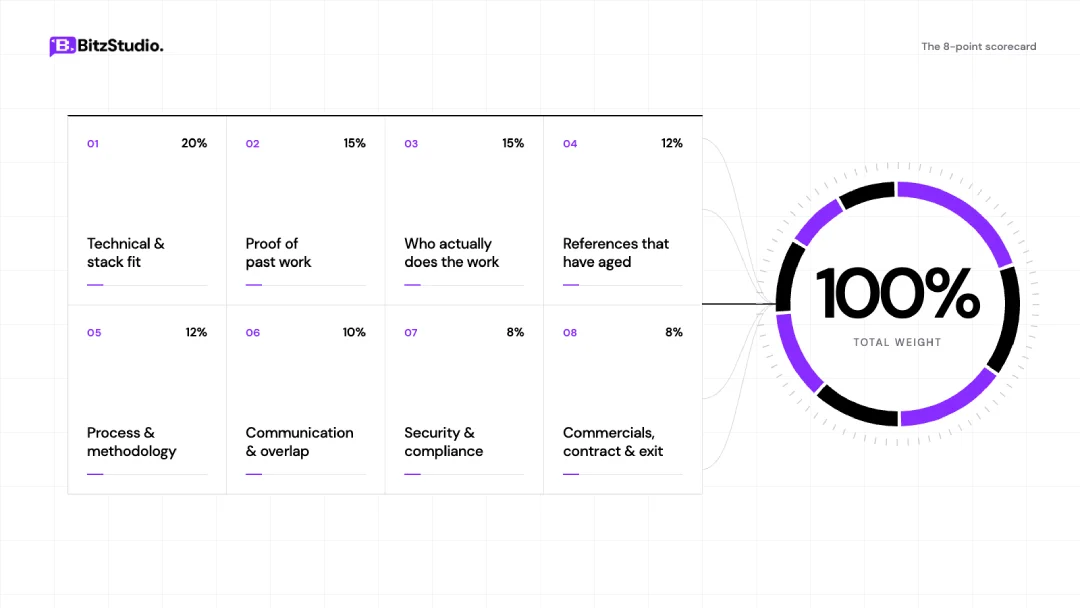
Most guides hand you a list of qualities to look for and leave you to guess how to weigh them. That’s how three agencies end up looking equally good on paper. A scorecard forces you to separate what a vendor claims from what you actually verified.
Score each shortlisted firm out of 10 per criterion, apply the weights, and compare totals. Aim for five to seven vendors at this stage fewer and you lack a baseline, more and the process collapses under its own weight.
| Criterion | Weight | How to verify (not just ask) |
| Technical and stack fit | 20% | Code sample review, GitHub activity, architecture walkthrough judged on maintenance cost not novelty |
| Proof of past work | 15% | Ask to use a live production product they built from scratch |
| Who actually does the work | 15% | Named engineers with CVs, a direct technical call, tenure data, subcontracting disclosure |
| References that have aged | 12% | Calls with clients past the two-year mark |
| Process and methodology | 12% | Agile, Scrum or Kanban in practice sprint cadence, demo schedule, retro habits |
| Communication and overlap | 10% | Timezone overlap hours, PM tooling (Jira, Linear, Notion), reporting rhythm |
| Security and compliance | 8% | ISO 27001, SOC 2 Type II, GDPR, HIPAA or PCI-DSS as your sector requires |
| Commercials, contract and exit | 8% | Pricing model, change-order process, handover plan, maintenance SLA |
A few of these deserve unpacking, because they’re where evaluations most often go wrong.
Proof of past work: use the product, don’t watch the demo
Logo walls prove someone paid an invoice. A curated demo proves someone rehearsed. Neither tells you whether the software holds up.
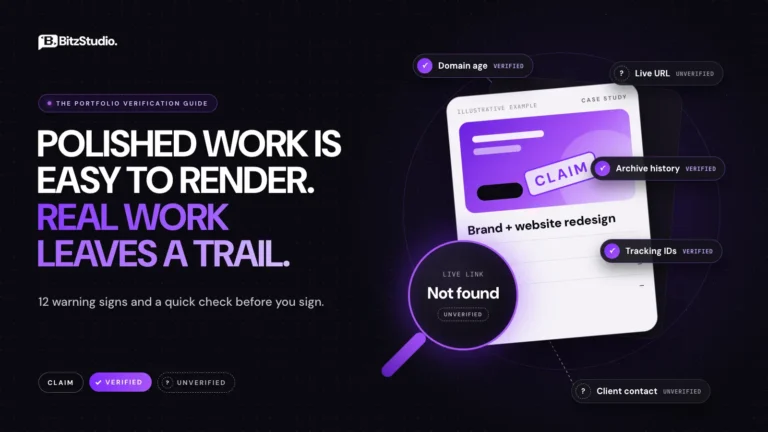
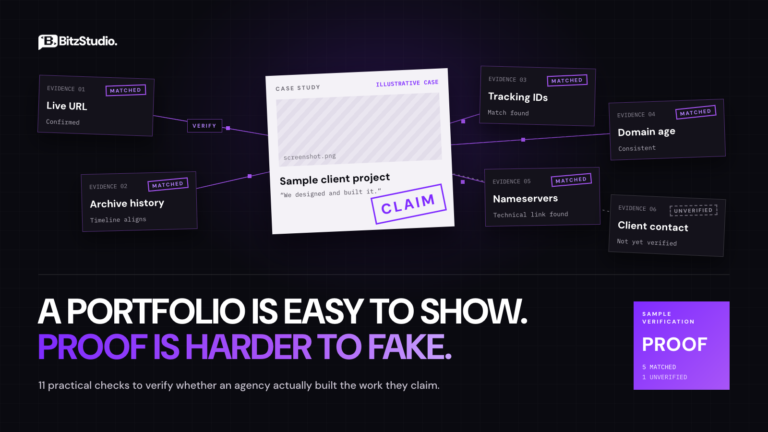
Ask for access to a live, production-level product the agency built from scratch, and spend twenty minutes using it like a real customer would. Sign up. Break something. Check it on a phone. If an agency can’t point you to anything shipped and running, that’s your answer.
Who actually does the work
This is the single biggest gap between what’s sold and what’s delivered. The architect in your pitch meeting may be a shared resource across eight accounts, and the people writing your code may not be on the payroll at all.
Four things to establish before you sign:
- Names and CVs of the specific engineers assigned to you.
- A direct technical call thirty minutes with those engineers, without an account manager steering the conversation.
- Average employee tenure. Low turnover and stable technical leadership matter more than headcount. High churn means your project knowledge walks out the door on a schedule you don’t control.
Subcontracting disclosure. Ask plainly how much of the work stays in-house. Subcontracting isn’t automatically bad, but undisclosed subcontracting is.
References that have aged
A three-month-old reference tells you the onboarding was pleasant. A two-year-old reference tells you whether the architecture survived contact with real traffic, real data, and real feature creep.
Ask specifically for clients past the two-year mark. Then ask those clients one question most people skip: what did it cost you to change something the agency built after they’d moved on?
The architecture conversation
You don’t need to be technical to judge this one you need to listen for what the answer is anchored to. A mature team explains why a particular stack fits your business: what it costs to maintain in year three, how easily you’ll hire for it later, what it would take to migrate off it.
A weaker team names trending technologies and leaves the business case implied. Enthusiasm for a framework is not a strategy, and you are the one who inherits the maintenance bill.
Takeaway: every criterion on the scorecard has a verification method. If you only asked and never checked, the score isn’t real.
Where the AI Question Changes Everything
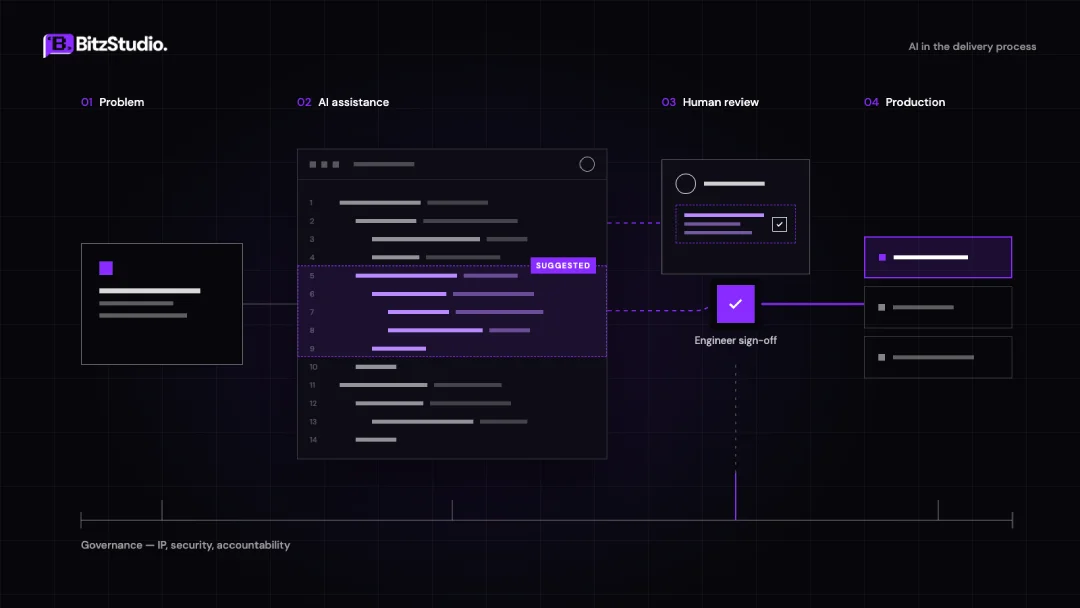
Every agency now ships AI-assisted code. GitHub’s own controlled study of 95 developers found that those using Copilot completed a defined coding task 55% faster than those who didn’t, and the tooling has only broadened since Copilot, Cursor, Claude Code and others are simply part of how software gets written in 2026.
So the question isn’t whether your partner uses AI. It’s what happens after the AI writes something, and whether they can tell the difference between AI-assisted delivery and genuine generative AI engineering. Ask these four:
- “What share of this project’s code will be AI-generated, and who reviews it?” You’re listening for a named human review step, not a shrug.
- “What does the contract say about the IP status of AI-generated code?” Most standard agreements were written before this mattered. Yours shouldn’t be.
- “If AI makes your team significantly faster, why hasn’t the estimate come down?” A fair answer exists review overhead, architecture work, QA but it should be given, not dodged.
- “Does our data go into AI tools, and on which tier?” Enterprise tiers with no-training guarantees are a different proposition to consumer accounts. If you handle regulated data, this is a compliance question, not a curiosity.
If your product touches EU users, add one more: how do they handle the obligations arriving under the EU AI Act? A partner who has thought about it will say so in a sentence. A partner who hasn’t will change the subject.
Key Takeaway: speed gains from AI should show up in your timeline, your price, or your quality. If none of the three moved, ask where they went.
Contract Clauses Most Founders Never Read
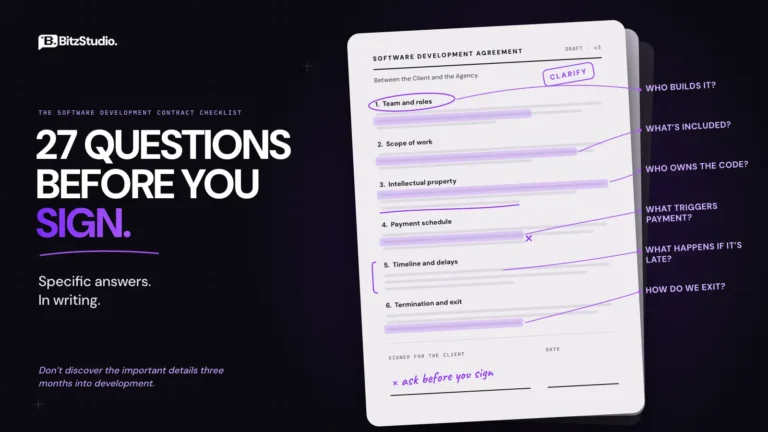
This is where the real risk lives, and it’s the part almost nobody writes about. The clauses below are ordinary and negotiable you just have to know to ask.
MSA vs SOW. The Master Service Agreement governs the relationship: IP, liability, confidentiality, termination. The Statement of Work governs one specific engagement: scope, deliverables, timeline, price. Commercial disputes usually happen because something belonged in the MSA and got buried in an SOW instead.
IP assignment, and when it triggers. Many contracts transfer intellectual property “upon final payment.” That sounds reasonable until a project stalls at 80% and you own nothing. Push for assignment on milestone payment, so what you’ve paid for is already yours.
Repository ownership from day one. The GitHub, GitLab or Bitbucket organisation should be yours, with the agency invited in as collaborators. This is the most common trap in the industry and the easiest to avoid. If the repo lives in their org, your leverage at handover is whatever goodwill remains.
Several more clauses are worth ten minutes of your lawyer’s time:
- Change order process — the out-of-scope hourly rate, who approves changes, and above what value written approval is required.
- Subcontracting — whether it’s permitted, to whom, and whether you’re notified.
- Non-solicitation — it should cut both ways, and it shouldn’t outlast the engagement by years.
- Warranty period — how long post-launch bug fixes remain free, and what counts as a bug versus a new feature.
- Source code escrow — worth it when the software is business-critical and the vendor is small.
- Termination and handover — spell out exactly what you receive: repository, documentation, credentials, environment configs, CI/CD pipeline, and a named handover window.
- Data Processing Agreement — required if GDPR applies, and increasingly expected regardless.
Key Takeaway: you are not negotiating against the agency here. A good partner will happily sign all of this, because a clean exit clause is also how they prove they don’t need one.
Pricing Models and What Actually Drives Your Number
Four engagement models dominate this market, and each fails in a predictable way. Fixed price protects your budget but punishes change it works only when scope is genuinely locked. Time and materials flex with reality but requires trust and active oversight.
A dedicated team or staff augmentation arrangement suits longer roadmaps where you want continuity and direct management. A retainer fits maintenance and steady iteration after launch. Most healthy engagements start fixed-price for a small discovery, then move to time and materials or a dedicated team for the build.
Rather than trusting a published rate card, work out what’s actually moving your number:
| Cost driver | Effect on price | What to ask |
| Geography | The largest single variable North America and Western Europe sit at the top, Latin America and Eastern Europe in the middle, South and Southeast Asia at the lower end | What’s the blended rate, and what seniority mix does it assume? |
| Seniority mix | A team of four seniors costs far more than two seniors and two juniors, and ships differently | How many years’ experience per assigned engineer? |
| Timezone overlap | Fewer overlap hours means slower feedback loops and more elapsed time for the same work | How many hours a day overlap with my team? |
| Scope certainty | Vague scope gets priced defensively; clear scope doesn’t need the buffer | How much contingency is built into this figure? |
| Compliance burden | HIPAA, PCI-DSS or SOC 2 work carries audit and process overhead | Is compliance work inside this quote or billed separately? |
| Maintenance model | Year-one support is often quoted separately and can run a meaningful share of build cost | What does ongoing support cost after launch? |
Where we sit is no secret: BitzStudio is based in Lahore, which puts us in the lower-cost band. That’s context you should factor in, not a pitch the number that matters is total cost of ownership, meaning rate multiplied by hours, plus rework, plus the coordination overhead a distant timezone adds.
That’s also why the cheapest quote is so often the most expensive outcome. A bid that undercuts the field by 40% usually means someone misunderstood the scope, and misunderstood scope gets paid for later in change orders and rewrites.
Takeaway: compare quotes on assumptions, not totals. Two prices for “the same project” almost never describe the same project.
The 14 Questions Agencies Hate Answering
These are the questions that separate a rehearsed pitch from a real conversation. For each one, listen for the shape of the answer as much as the content.
1. Will the developers I interviewed be named in the contract?
Good: “Yes, and here’s our clause on notifying you before any change.” Bad: “Our whole team is strong.”
2. Can I have thirty minutes with those engineers directly, without an account manager on the call?
Good: “Sure, when works?” Bad: Any version of “our process is to keep technical discussions channelled through delivery management.”
3. What’s your average employee tenure, and how much of this project would be subcontracted?
Good: A number, and a straight answer about partners they use. Bad: “We have access to a large talent network.”
4. Of your last three projects, how many shipped on time?
Good: “Two. The third slipped six weeks here’s why.” Bad: “All of them.”
5. Can I use a live product you built from scratch the real thing, not a demo?
Good: A URL. Bad: An NDA excuse covering every project they’ve ever done.
6. Can I speak to a client you’ve worked with for more than two years?
Good: An introduction. Bad: A written testimonial as a substitute.
7. Name a client relationship that went wrong, and what you did about it.
Good: A specific story with an owned mistake. Bad: A story where the client was the problem.
8. Which organisation will the repository live in?
Good: “Yours. We’ll set it up in week one.” Bad: “Ours, and we transfer at the end.”
9. If a team member leaves, what’s the replacement process and who absorbs the ramp-up cost?
Good: A defined overlap period at their expense. Bad: “That rarely happens.”
10. Who approves a change request, and above what amount?
Good: A written threshold. Bad: “We’re flexible.”
11. How much buffer is in this estimate?
Good: A percentage and the reason for it. Bad: “It’s a precise estimate.”
12. What’s your review process for AI-generated code?
Good: A named review step and a testing standard. Bad: “We don’t really use AI.” In 2026, that’s either untrue or a different problem.
13. At handover, what exactly do I receive?
Good: A list, before you ask for one. Bad: “Everything you need.”
14. What kind of project do you say no to?
Good: A clear, specific category. Bad: “We can handle anything.” This is the best filter question in the list, because an agency that never declines work has no standards to protect.
Takeaway: you’re not testing knowledge with these. You’re testing whether the person across the table is comfortable being specific.
Red Flags and Green Flags
The strongest positive signal in any vendor conversation is pushback. An agency worth hiring will challenge your assumptions before it quotes asking about your business model, your actual users, which features could be cut, and what happens if the core assumption turns out to be wrong.
An agency that agrees to every feature request in the first meeting isn’t being accommodating. It’s selling, and it will send you a change order in month three.
Green flags:
- They advise you to cut scope, even though it reduces their invoice
- They answer a hard question with “I don’t know let me check and come back to you”
- They propose a paid discovery instead of quoting a large build blind
- They connect you directly with a past client without being pushed
- They raise the exit and handover clause themselves
Red flags:
- A quote arrives without a single clarifying question
- The senior engineers in the pitch aren’t the ones in the contract
- Work is quietly subcontracted, and you find out later
- High team churn, or engineers who stay unnamed
- Stack recommendations driven by trends rather than your business case
- “We do everything” every service, every industry, every platform
- No discovery conversation before the NDA
- The repository lives in their organisation
- Refusal to arrange a reference call
- Sudden discounts when you hesitate
- A fixed price quoted against a vague scope
- No written process for handling change
Key Takeaway: discount pressure late in a sales cycle tells you the original number was negotiable. Ask yourself what else was.
De-Risk With a Paid Pilot
Never open with a large fixed-price contract. The single most effective risk reducer available to you is a small, paid engagement that tests the relationship before the money gets serious.
Commission a two-to-four week paid discovery sprint, or one self-contained module you genuinely need. Expect to receive an architecture document, a clickable prototype or working slice, and a refined estimate grounded in what was learned. Paying for this is the point free discovery produces sales documents, not engineering.
The pilot is a behavioural test as much as a technical one. Score three things explicitly:
| What you’re testing | What good looks like |
| Communication cadence | Updates arrive without you chasing; bad news arrives early |
| Deadline adherence | The two-week commitment lands on the day it was promised |
| Problem-solving under pressure | When something breaks, you get a diagnosis and options not excuses |
Two further signals are worth watching. Did they push back on anything during the sprint? And did the estimate move honestly afterwards including upwards, with reasons rather than conveniently confirming the number they’d already given you? One clause to insist on: whatever the pilot produces is yours, whether or not you continue. Documentation, designs, code, research. A partner confident in their work won’t hesitate.
After You Sign: The First 30 Days
The habits set in month one persist for the whole engagement. Most projects that go badly were already drifting by week three; nobody wanted to say so.
Lock these down in the first week:
- Repository access in your organisation, with your team as owners
- CI/CD pipeline and a working staging environment
- A single shared communication channel, with agreed response expectations
- A sprint calendar with fixed demo dates, not “we’ll show you when there’s something to see”
- Named escalation contacts on both sides
Then agree on a reporting format and hold to it. Three data points are enough: budget burned against budget planned, velocity or completed scope, and current blockers with owners. If a status update takes a meeting to interpret, it isn’t a status update.
Set a formal 30-day checkpoint before work begins a scheduled conversation where either side can raise concerns honestly. At day 30 the cost of course-correcting, or walking away, is still small. At day 120 it isn’t.
How We Work at BitzStudio
We’re a software team based in Lahore, founded and still run by the people who do the work Ahsaan Ali Khan as CEO and Asif Younas as CTO. Over five years we’ve delivered more than 200 projects across custom software, web development, mobile apps, frontend engineering, UI/UX design and WordPress builds.
You can apply this article’s advice to us directly. Our portfolio includes live, production products Lockr, Super Auto Haul, Go Chicken Go, Paying4, Furama and SakaEm and we’ll introduce you to the clients behind them rather than sending a testimonial. The engineers you meet are the engineers who build repositories in your organisation from day one, and we’d rather start with a paid discovery than a large contract neither of us can scope yet. We also say no. Projects that need deep regulatory specialisation we don’t hold, or timelines that only work if quality gets quietly removed, we’ll refer elsewhere. If you’d like to test any of that, start a conversation a scoping call costs you nothing and tells you a great deal.
Frequently Asked Questions
How much does it cost to hire a software development agency?
There’s no honest single figure, because geography, seniority mix, scope certainty and compliance requirements each move the number substantially. The reliable approach is to send the same written brief to four or five shortlisted firms and compare their assumptions rather than their totals that spread will tell you far more about realistic market pricing for your specific project than any published rate card.
How long should choosing an agency take?
Three to six weeks for most mid-sized projects: one week to write the brief, one to two to build a shortlist and hold first calls, one to two for technical conversations and reference checks, and a final week for contract review. Add two to four weeks if you run a paid pilot, which is usually time well spent.
Agency or freelancer for an MVP?
A freelancer works when the MVP is narrow, technically simple, and you can manage delivery yourself. An agency is better when you need design, backend, mobile and QA simultaneously, or when you can’t afford the project to stall because one person got sick.
Who owns the code when you hire an agency?
You should but only if the contract says so explicitly. Push for IP assignment on milestone payment rather than final payment, and make sure the repository sits in your organisation from the first commit. Without those two things in writing, ownership is a promise rather than a right.
What is a paid discovery phase, and should you pay for it?
It’s a short, funded engagement usually two to four weeks producing an architecture plan, a prototype or working slice, and a refined estimate. Yes, pay for it. Free discovery produces a sales document; paid discovery produces engineering you own regardless of what you decide next.
How do you check whether an agency’s portfolio is real?
Ask to use a live production product they built from scratch, then verify independently: check the app store listing, look for the client’s own public references to the project, and ask for a call with someone who worked on it. Screenshots and logo walls prove nothing.
How do you know the developers you interviewed will be the ones who build it?
Get their names in the statement of work, ask for a direct technical call without an account manager present, and negotiate a clause requiring notice plus a paid overlap period before any substitution. Also ask about average employee tenure and how much work is subcontracted.
What’s the difference between nearshore and offshore development?
Nearshore means a nearby region with substantial working-hour overlap — Latin America for US companies, Eastern Europe for Western Europe. Offshore means a distant timezone with limited overlap, usually at a lower rate. Nearshore buys you real-time collaboration; offshore buys you budget, provided you plan the overlap deliberately.
What should you do when the agency relationship isn’t working?
Raise it formally and in writing before it becomes a dispute, with specific examples and a two-week improvement window. If nothing changes, trigger your termination clause and use the handover terms you negotiated at the start repository, documentation, credentials, environments. This is precisely why those clauses exist.